LOADING PROSPECTS
INITIALIZING_DATABASE...
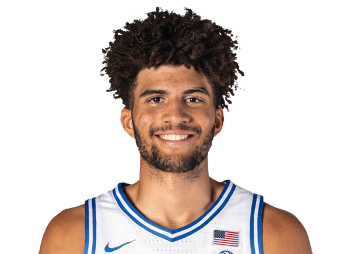
Wingspan estimated from public web sources.
On the Inductive Error of the "Verticality" Critique There is a particular species of skepticism that arises whenever an athlete refuses to perform the expected theatre of his position. In the contemporary basketball imagination, the elite forward is envisioned as a creature of flight—a kinetic explosion that solves the problem of the basket through sheer aerial defiance. When a prospect arrives who is 6’9”, possesses a frame of substantial density, and operates primarily through a series of grounded, calculated maneuvers, the conventional mind recoils. It observes the absence of the spectacular and concludes an absence of the essential. This is the "Verticality Critique," a doctrine which asserts that any player who does not live above the rim is destined to be a relic of a previous era. Regarding Cameron Boozer, this critique is not merely flawed; it is a fundamental misapprehension of how offensive value is actually generated. To evaluate a player based on his proximity to the rafters is to confuse the quality of an act with its aesthetic flourish. It is a failure of logic. The goal of the game is the efficient conversion of possession into points, and in this pursuit, Boozer functions with a mathematical coldness that borders on the absolute. The first principle of offensive basketball is efficiency relative to volume. Most players are forced to choose between the two. To maintain high efficiency, one must usually limit one’s attempts to the most curated of circumstances; to increase volume is almost invariably to invite a degradation of accuracy. Boozer, however, presents a shot chart that resembles a monument to disciplined logic. He is insanely efficient on ultra-high volume. This is not the result of fortunate variance. It is the result of an intuitive grasp of spatial geometry. He understands that the shortest distance between two points is not always a straight line, but often a well-timed seal, a precise pivot, or a perfectly weighted pass. One must look beyond the simple act of scoring to see the true nature of his utility. There exists a category of player who is a "connector"—an individual whose value is found in the spaces between actions. Boozer is such a player, yet he possesses the gravity of a primary. He generates positive offensive value even at lower usage rates because his participation in a possession is never wasteful. He is a master of the secondary assist, a screen-setter of immovable mass, and a rebounder who treats the glass as a private inheritance. To possess a player who can function as a high-volume hub while simultaneously offering the scalability of a role-player is to possess a rare structural advantage. He is, in essence, a more refined version of the modern offensive archetype exemplified by players like Alperen Şengün—a hub who can finish inside with both power and touch, yet threaten from the perimeter with a respectable and improving three-point stroke. The skeptics, however, are rarely satisfied by offensive dividends alone. They retreat to the defensive end of the court, where they invoke the specter of the "dTS" factor—the defensive true shooting impact. This is the most legitimate area of inquiry. The argument suggests that a forward who lacks elite verticality will inevitably fail as a rim protector, thereby allowing opponents to convert at an elevated rate. They see a 6’9” frame that does not leap with the suddenness of a pouncing feline and they predict a defensive vacuum. But this argument rests on a narrow definition of defense. It assumes that the only way to prevent a basket is to swat the ball into the third row. In reality, defense is an exercise in the management of probabilities. While Boozer may not offer the shot-blocking intimidation of a traditional rim-protecting center, he offers the defense of mass and position. At the power forward position, he possesses a significant strength advantage against almost any contemporary peer. He moves exceptionally well for his size, utilizing his weight not as a tether, but as a displacement tool. A player who wins the battle of the box-out and secures the defensive rebound is performing an act of defense just as surely as the one who blocks a shot. One prevents the attempt; the other terminates the possession. Boozer’s elite steal rate and his projected excellence in defensive rebounding and turnover generation suggest a player who understands that defense is a game of disruption and possession-ending. The concern regarding his contest value is real, yet it must be weighed against his ability to deny second chances and his capacity to guard the post through sheer physical refusal. To suggest he is a defensive liability is to ignore the utility of the "immovable object" in a game increasingly populated by "unstoppable forces." Furthermore, there is the matter of the six RAPM factors—the statistical proxies for impact that strip away the noise of the box score. Boozer shows significant potential in all six. This is not common. Most prospects have a glaring void where one or more of these factors should reside. They may score but cannot pass; they may defend but cannot rebound; they may shoot but cannot create. Boozer’s profile is one of startling completeness. He is a versatile offensive instrument who maintains elite shot discipline while exerting pressure across every phase of the game. The error of the critic lies in the belief that "upside" is a synonym for "athletic mystery." They see a player who is already polished, already efficient, and already physically developed, and they assume the ceiling has been reached. This is a variety of the Gambler’s Fallacy applied to scouting: the belief that because a player is already good, he cannot become much better. They prefer the raw, unformed athlete—the one whose highlights are a series of vertical promises—because they can project onto that emptiness whatever greatness they desire. Boozer offers no such emptiness. He offers evidence. He is a player who understands that basketball is a game of leverage. He uses his frame to create angles that others try to find through speed. He uses his passing to collapse defenses that others try to penetrate through dribbling. He uses his touch to finish plays that others try to finish through dunks. This is not a "below-the-rim" game in the sense of a limitation; it is a "high-intelligence" game in the sense of a choice. If he does not jump, it is often because he has already won the position, and jumping would be a superfluous expenditure of energy. The debate over his defensive projection will likely persist until he is forced to guard elite NBA wings and mobile bigs in space. The processing speed of his rotations and his ability to maintain his contest value without elite length are the variables that will determine the difference between a high-level starter and a perennial All-NBA candidate. This is a substantive discussion. It is a debate about the limits of physical archetypes in the face of modern offensive spacing. However, to dismiss his overall profile based on an aesthetic preference for verticality is to commit a grave intellectual error. It is to value the method over the result. If a player produces elite efficiency on high volume, facilitates for his teammates, dominates the boards, and disrupts the opponent’s flow, it matters very little how high his head rises above the rim during the process. The history of the sport is littered with the careers of "explosive" athletes who could not find their way into a coherent offensive system. It is much rarer to find a player with Boozer’s combination of mass, skill, and processing speed who fails to impact winning. He is a connector who can also be a centerpiece, a technician who can also be a bruiser. In the final analysis, we must distinguish between the spectacle of the athlete and the efficacy of the player. The former provides entertainment; the latter provides victories. The skeptical narrative surrounding Cameron Boozer is a product of the human tendency to overvalue what is visible and undervalue what is structural. We see the lack of a highlight-reel leap, but we fail to see the persistent, grinding logic of a player who consistently makes the right play, at the right time, in the right place. Truth in basketball, as in philosophy, is often found in the things that are too simple for the sophisticated to notice. It is found in the box-out, the entry pass, the disciplined close-out, and the efficient layup. To ignore these virtues in favor of a vertical fetish is to prefer a beautiful lie to a plain truth. And the truth of Cameron Boozer is that he is a basketball player of the highest order, whose game is built not upon the shifting sands of athleticism, but upon the solid rock of efficiency and intelligence. In a world of jumpers, the man who knows where to stand is king.
| Date | Opponent | Min | USG | TS% | Pts|Reb | Ast|Tov | Stl|Blk | FG | 3P | FT | GmSc |
|---|---|---|---|---|---|---|---|---|---|---|---|
No box score data available for this season | |||||||||||

Wingspan estimated from public web sources.
On the Poverty of the "Midrange Merchant" Critique There exists a form of criticism that confuses taxonomy with analysis. It observes that a prospect takes a substantial number of midrange shots, recalls that midrange-heavy scorers have occasionally disappointed, and concludes—without further inquiry—that the present case belongs to the same lineage. The verdict is delivered with an air of analytical modernity. In reality, it is a shortcut. Midrange is not a vice. It is a role-dependent instrument. For non-primaries—players who do not bend defenses, who do not draw fouls, who do not collapse the paint—midrange volume is often wasteful. It is a consolation prize taken after advantage fails to materialize. But for primaries, the midrange is the counterpunch. It is what remains when the rim is crowded and the three-point line is chased. The postseason is littered with possessions in which only those who can create from twelve to eighteen feet survive. The first question, therefore, is not "Does he take midrange shots?" It is "Is he a primary?" AJ Dybantsa's statistical and film profile answers that question with unusual clarity for a 19-year-old forward. A 6'9" wing under twenty converting 60% from two—nine percentage points higher than Kevin Durant did in college—finishing 75% at the rim, and drawing free throws at a rate nearly unprecedented for his demographic is not functioning as a play finisher. He is exerting pressure. And pressure is the defining attribute of a primary creator. Yet not all midrange attempts are equal. A contested pull-up taken as a first resort is folly. A midrange threat used as bait is strategy. Dybantsa's interior efficiency suggests that his shot profile is not wasteful but functional. The midrange is, in his case, frequently the prelude to something else. Defenders who respect his elevation are made to pay for their credulity; those who crowd him are displaced by strength and stride. One must distinguish between a player who arrives at the midrange because he cannot reach the rim, and one who passes through it because he can. The former stagnates. The latter evolves. The heat map that critics cite as evidence of midrange excess reveals something else entirely: dense paint touches, short interior attempts, and fouls generated through manipulation. His pump fakes induce lift-offs. His pivots displace balance. His step-throughs manufacture rim attempts or free throws. These possessions do not terminate advantage—they create it. To call this "midrange heavy" without distinction between deep long twos and paint-level counters is to confuse color gradients with mechanics. It is shot-chart pattern matching masquerading as evaluation. The historical failures so frequently invoked shared a different profile. They lacked elite foul-drawing. They lacked consistent rim pressure. They lacked passing indicators. They lacked mobility at size. They settled because they could not collapse. Dybantsa collapses. Moreover, the forward playmaking critique often collapses into false binaries. College forwards are rarely tasked with orchestration. If a player already ranks in the upper percentiles of assist rate among drafted forwards while generating this degree of rim pressure, he is not exhibiting the statistical footprint of a tunnel-vision scorer. He is demonstrating scalability. Perhaps most revealing is the unwillingness to grapple with mobility. Many prospects of similar size have failed because they could rise but not displace, shoot but not shift. Dybantsa's ability to move with the ball—fluidly, dynamically—changes the geometry of the court. A 6'9" player who accelerates and decelerates like a guard is not merely tall; he is disruptive. Those who dismiss this trait tend to do so because it is difficult to quantify, not because it is unimportant. The deeper irony is this: many who dismiss his midrange volume simultaneously praise rim pressure as the gold standard of translatability. Yet when presented with a forward who draws free throws at an extraordinary rate and converts efficiently inside the arc, they retreat to aesthetic discomfort. The concern worth having lies elsewhere. Defensive projection remains the most legitimate uncertainty. Without extraordinary length, engagement and processing speed will determine whether he becomes merely very good or genuinely great. That debate is substantive. But to reduce his offensive profile to a pejorative label is not substantive. It is superficial. Midrange is a liability when it substitutes for pressure. It is a weapon when it compounds it. If Dybantsa were projecting as a complementary scorer, the criticism might hold. But his current profile suggests something rarer: a forward who moves with guard fluidity, draws fouls at historic rates, finishes efficiently, and manipulates defenders in tight spaces. That is the profile of a potential primary. To evaluate him otherwise is not skepticism. It is the refusal to distinguish between tool and usage, between archetype and individual, between fashion and fact. And in basketball, as in philosophy, such refusals rarely age well.
| Date | Opponent | Min | USG | TS% | Pts|Reb | Ast|Tov | Stl|Blk | FG | 3P | FT | GmSc |
|---|---|---|---|---|---|---|---|---|---|---|---|
No box score data available for this season | |||||||||||

Wingspan estimated from public web sources.
On the Poverty of the "Primary Facilitator" Critique There is a peculiar dogma in contemporary basketball analysis which insists that a guard must be either a merchant of assists or a perpetrator of inefficiency. This perspective posits that if a lead player does not spend his tenure on the court as a frantic distributor of the ball, he is somehow failing a fundamental moral test of the position. It is a view that mistakes the ledger for the literature. When applied to Darryn Peterson, this critique reveals more about the limitations of the critic than it does about the capacities of the player. The primary indictment leveled against Peterson is a perceived lack of playmaking, usually evidenced by a modest assist rate that fails to satisfy the cravings of those who worship at the altar of the "pure point guard." It is a concern that may be dispatched with a brief appeal to the facts of his current role. Peterson is frequently deployed as an off-ball weapon, a relocator, and a finisher rather than a dedicated initiator. To judge a player’s passing instincts while he is tasked with gravity-generation is like judging a mathematician’s prose while he is solving a differential equation. The activity in question is simply not the one currently being performed. The assist, as a statistical unit, is a function of possession time and system design. For Peterson, the low numbers are the byproduct of a specific utility—he is operating as a pressure point, not a pivot. Once we move past this arithmetic preoccupation, we find a profile of such overwhelming offensive potency that the "playmaking" question begins to look like a distraction from the main event. The real argument concerns the totality of Peterson’s offensive evolution. We are witnessing the emergence of a guard who has deliberately reconstructed his game for the modern geometry of the court. The evidence is found in the sheer audacity of his shooting profile. To convert forty-one percent of three-point attempts while launching fourteen per one hundred possessions is not merely "good shooting." it is an act of structural disruption. In his earlier iterations, Peterson was often described as a "three-level scorer" with a penchant for the mid-range—a description that usually implies a certain stubbornness in shot selection. However, the data suggests a conscious migration. He has embraced the three-point line with the zeal of a convert. His free-throw percentage, which has hovered between eighty and eighty-five percent across various samples, serves as the ultimate arbiter of his touch. This is not a hot streak; it is a fundamental skill. This evolution brings us to the most delicate point of the analysis: the comparison to Stephen Curry. To suggest that any teenager will equal the greatest shooter in human history is an act of journalistic malpractice. However, to observe that Peterson is following the Curry *blueprint* is an act of taxonomic precision. The Curry blueprint is not defined by height or even by the specific result of the shot, but by the method of offense. It is characterized by elite shooting volume, constant off-ball movement, and the ability to maintain efficiency while operating in a role that prioritizes gravity over traditional distribution. Peterson possesses the requisite guard fluidity and the 6'10" wingspan to execute this model at a higher physical threshold than many of his peers. He understands that in the modern game, a guard who can shoot with this volume and move with this purpose creates more "playmaking" through the defensive panic he induces than he ever could through a simple chest pass. The scouting community has often noted his "advanced footwork" and "size to bully smaller guards," but these are secondary traits. The primary trait is his cognitive grasp of efficiency. He has recognized that the most valuable version of himself is one that forces the defense to make impossible choices across thirty feet of hardwood. One must, however, maintain the rigor of skepticism. A philosophy that ignores contradictory evidence is merely a prejudice. There exists a legitimate concern regarding Peterson’s defensive translation. In the pre-collegiate sample, his defensive playmaking was nothing short of extraordinary—averaging four steals and two blocks per forty minutes. These are the numbers of a disruptive titan, a player whose length and instincts allow him to teleport into passing lanes and erase attempts at the rim. Yet, this defensive production has not fully manifested in the NCAA. The skeptics point to this as evidence of a level-of-competition fatigue or a lack of engagement. A more nuanced inquiry suggests a physical explanation: the hamstring injury that has hampered his mobility. In basketball, as in physics, you cannot exert force if your lever is compromised. Whether his defensive impact will return to its historic highs remains the most pertinent question for his professional projection. If the steals and blocks return, he becomes a unicorn of the "six-factor" RAPM variety—a player who optimizes offensive true shooting and low turnovers while simultaneously generating defensive turnovers and suppressing the opponent's efficiency. If we evaluate Peterson through the lens of first principles, we see a player who has identified the highest-value actions in the sport and mastered them. He limits turnovers because he is a finisher, not a middleman. He maintains elite true shooting because he has replaced difficult twos with high-volume threes and frequent trips to the charity stripe. He uses his 6'10" wingspan not just to disrupt, but to ensure his own shot remains unbothered. The "pure guard" critique is a relic of an era when roles were static and the court was cramped. It fails to account for the player who understands that the most effective way to help one's teammates is to become an unguardable problem for the opposition. Peterson is not "failing" to be a playmaker; he is succeeding at becoming a primary engine. Those who continue to lament his assist numbers are like the critics of the early twentieth century who dismissed modern art because it did not look like a landscape. They are looking for a familiar form and missing the revolutionary function. Peterson has demonstrated a rare intellectual clarity in his development. He knows who he needs to be. He has the frame, the fluidity, and the flamethrower. In the final analysis, the value of a prospect is not determined by how well he fits into a pre-existing box, but by how effectively he breaks the box of the opponent. Peterson is a box-breaker. His game is built on the realization that shooting is the ultimate currency, and he is currently operating with a very full treasury. To conclude that he is a "limited" guard because he does not play like a traditional floor general is a triumph of nomenclature over reality. He is an elite offensive weapon whose defensive ceiling remains high, despite the temporary fog of injury. He is building something more sophisticated than a traditional guard's resume. He is building a career on the premise that gravity, when harnessed correctly, is the most powerful force on the court. And in basketball, as in the cosmos, the largest masses always dictate the movement of everything else. Those who refuse to see this are not being rigorous; they are merely being nostalgic for a game that no longer exists.
| Date | Opponent | Min | USG | TS% | Pts|Reb | Ast|Tov | Stl|Blk | FG | 3P | FT | GmSc |
|---|---|---|---|---|---|---|---|---|---|---|---|
No box score data available for this season | |||||||||||
AJ Dybantsa is a Wing F from BYU, ranked #2 on the DRAFTBALLR 2026 NBA Draft Big Board. Averaging 25.5 points, 6.8 rebounds, and 3.7 assists per game.
View all 2026 NBA Draft prospects with scouting reports and analytics.